


Your office chair can't go 300 km per hour. There are probably more than 20 positions in the world you would describe as dream jobs. Nevertheless, you can certainly find inspiration in the thoughts racing driver Kevin Magnussen has had throughout his career. Thoughts about setting goals, collaborating with his team, and performing under maximum pressure. Barons met him in Copenhagen for a chat about just that.
Kevin Magnussen greets us with his eight-month-old daughter in his arms. He has just become a father, moved to Denmark, and let go of a 20-year goal of becoming a Formula 1 world champion. At one point, he says he almost considers 2020 a gap year. If that's true, it's a gap year in a very goal-oriented 28-year-old's life.
Kevin Magnussen quickly dispels all theories that success requires setting high but realistic goals.

The goal is to be the best
“For me, goals are irrelevant. There can only be one overarching goal, and that is to be the best, to win. My overarching goal has always been to become a Formula 1 world champion. You don't get very far if you're satisfied with anything less than the best in sports,” says Kevin Magnussen calmly and as the most natural thing in the world when asked about his goals as a racing driver.
As most people will know, it's a goal he hasn't achieved. For seven years, from 2014, he drove Formula 1 for McLaren, Renault, and Haas. In 2020, he left the sport, and he's unlikely to return.
“It's been tough. It was so deeply ingrained in me that becoming a world champion was my goal. Getting into Formula 1 wasn't a success in itself for me. I just think that holding on to my overarching goal of becoming a world champion drove me to even get into Formula 1. But you also have to, when you've chosen to stop, say, I've done the best I can. You have to look back on it and see if you can't be satisfied anyway,” says Kevin Magnussen.

He also talks about some of the experiences in Formula 1 that he can now look back on with joy. Among other things, the first race in Melbourne, where he finished 3rd and became 2nd after a disqualification. He just doesn't dwell much on those experiences – he looks forward. The new goal is to win the 24-hour Le Mans race with the Peugeot team he will drive for next year.
Unofficial leader
Racing can look lonely. One driver behind the wheel. However, there are several hundred employees on a professional motorsports team working to get the car to run optimally. The reality for a racing driver is also that he is entirely dependent on the team and the car.
“The car has a big part of the responsibility for performance. That element is everywhere in motorsport, even if the cars are the same. There will always be an opportunity to set up the car in different ways,” he says.
Therefore, according to Kevin Magnussen, it's important to create a culture on the team where engineers aren't afraid to speak their minds and try out good ideas.
“As a driver, you have an indirect leadership role. You can make a huge difference in motivating the team because you are the one responsible for the final result. If you're down and think it's crap – and show it, it affects the team, and they lose faith in it too. If there's a poor engineer who made a mistake, and you go directly to him in front of everyone else and give him a hard time, then the other engineers might think; I need to be careful with what I'm doing. Then you create fear in the team,” says Kevin Magnussen.
He also doesn't spend much time blaming the car or the engineers for lack of results.
“You have to be self-critical enough to say: It might be the way I'm driving that's creating the problem. Should we try to solve it through the car's setup and design, or should I just adapt? It's a good idea to be honest with yourself because if it needs to be fixed on the human side, it takes focus away from developing the car,” he says.

Not an engineer
On race day itself, the driver is the boss. It's not possible to make fundamental changes to the car, so the driver, mechanic, and engineers work to get the perfect balance in the car, the balance that suits the driver best. It's a dance between the large amounts of data collected by sensors on the car and Kevin Magnussen's feel for the car.
“You have all these people sitting with data from the car and looking at what should perform better from a scientific standpoint. And then you have the driver's feel - and there needs to be a balance. It's the driver's gut feeling that weighs the most. During a race weekend, it's very much about the driver having a good feel for the car and that the balance is roughly what he needs. The car is improved between races, and that's where the engineers really need to perform. They need to attack the weaknesses in the car and improve them,” he says.
After a race, Kevin Magnussen gives feedback to the engineers. It's done both systematically and structured.
“I have lists of things to ensure I give feedback on the brakes, brake pedal, steering wheel, grip on the steering wheel, my seat position, the car's ability to go over bumps. From a to z. The more feedback you can give, the easier it is for the engineers to get to work. But it's also important to focus on what's most important,” he says about the report writing after the races.
Hard to handle pressure
The best football players play up to 50-60 matches a year and train almost every day. That's not how it is to be a racing driver. Throughout Kevin Magnussen's career, his season has been decided by between 10 and 15 race weekends with three test drives, a qualification, and a race – and there's hardly any training in the car between those weekends. In other words, there's extreme pressure every time Kevin Magnussen gets into the car. A pressure he hasn't always been good at handling.
“If I got a bad start to a championship, I could go too hard for the win and take too many chances. I wanted it so much, it meant so much to me, that when it didn't go well, it really affected my nerves and my mood,” he says.
Today, he has learned to focus by removing as many distractions as possible from his race weekends. It helps him get in the zone.
“I prefer just to focus on performance, and I really appreciate if there's someone who can keep track of all the practical things regarding when I need to be where and what things I need to remember. There are many meetings and things during a weekend, and if I have to keep track of what I need to do, I'll end up forgetting some of it, and it takes focus away. I feel like a diva when I say it, but I just want to be in the zone,” he says.

A long shower
He uses the zone to think about all the small and big things that can make a difference on race day. The car's setup, the strategy, and his own driving. It all helps him to “feel the car,” as he calls it. Kevin Magnussen is well aware that it can sound a bit abstract, but he compares the state to something very common.
“I imagine people can relate to standing in the shower. You don't concentrate on it, you just stand there and think. That's how I feel a lot during a race weekend. I feel like it's one long shower – that's the zone I'm talking about. It's not something I do anything to get into, it's just something that happens when I'm on the racetrack,” he says.
Next year, he will use that focus with the Peugeot team at the world championships in sports cars and attempt to win Le Mans.
What we learned from Kevin Magnussen
1. Create security in the team: If you want to perform at the top, everyone in the team must dare to come up with their best ideas. It requires creating security that mistakes don't lead to firing.
2. Give structured feedback and let your skilled people translate it into what needs to be done.
3. Remove distractions to get in the zone when you need to perform under pressure.
4. Be honest with yourself and actively look for areas where you can improve.
Kevin Magnussen: Look for your mistakes
“You have to look for your weaknesses. In other sports, it's practice that makes the difference. The feel of a tennis racket or a golf club. I also think football is becoming more data-driven, but especially in motorsport, it's really data-driven, and you can do so much to find your mistakes – and you have to want to. You can easily find excuses, but there are many things where you have to be self-critical enough to say: It might be the way I'm driving that's creating this problem.”
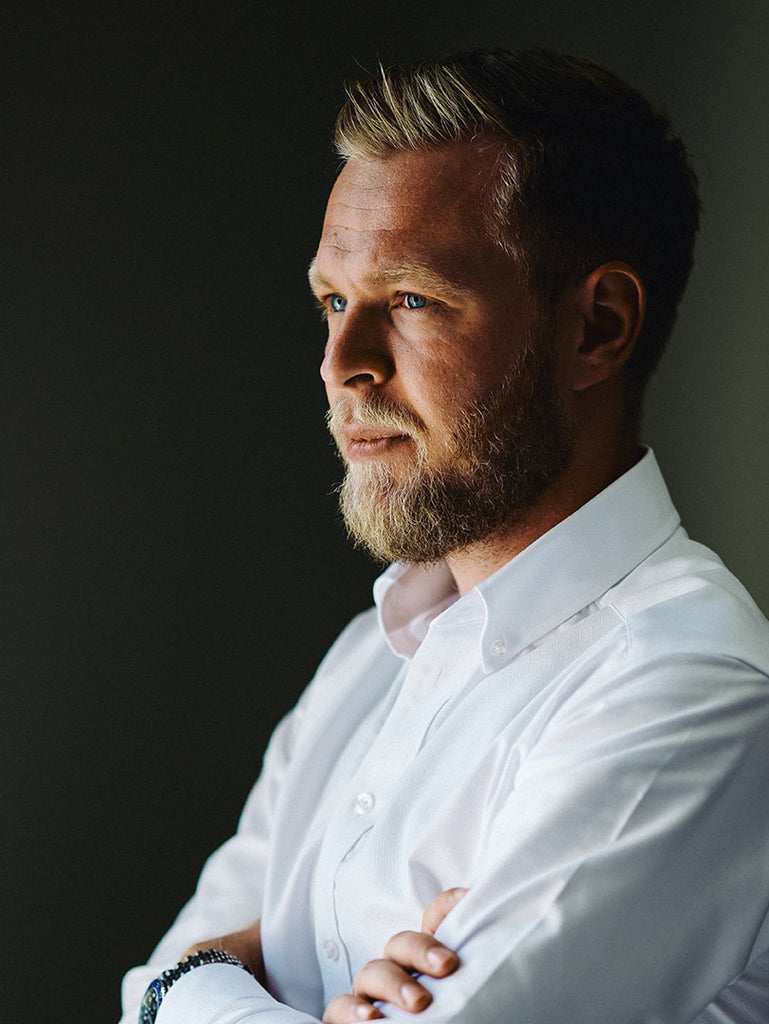
Kevin Magnussen in The Founder
MAN IN THE SHIRT “The credit belongs to the man who is actually in the arena, whose face is marred by dust and sweat and blood” - quote Theodore Roosevelt in Paris, 1910. In the portrait series “Man in the Shirt,” BARONS meets business people who have put themselves in play and at risk. Where do they find courage? What is the most important thing they have learned along the way? And what can the rest of us learn from them?


